Making the Pomodoro Technique survive an office job
· 4 min read
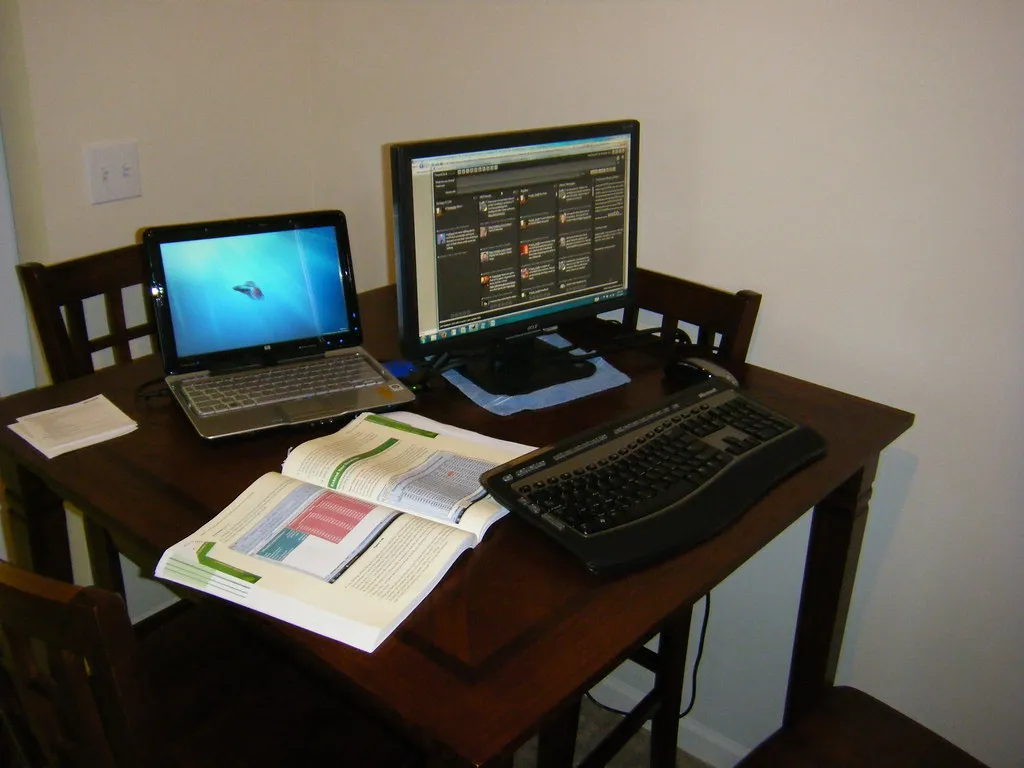
The Pomodoro Technique survives an office job, but not in its textbook form. The method was worked out by a student who owned his own hours; an office job hands most of your hours to other people. What survives contact is the core — one task, a fixed interval, a genuine break — and what has to bend is almost everything around it.
The method assumes a freedom you probably don’t have
The classic loop — twenty-five minutes of work, a five-minute break, a longer rest after four rounds — quietly assumes you can line up four uninterrupted sessions in a row. At a kitchen table in the late 1980s, you could. In a modern office you are sharing the day with a calendar you only partly control, a chat client that considers every message urgent, and colleagues who can materialise beside your desk mid-sentence.
None of this means the method is wrong for offices. It means the parts have different values there. The four-round cycle is the first casualty and the least important one. The bounded start and the one-task rule are the parts worth fighting for.
What survives contact
Two pieces of the technique come through an office day intact.
The first is the bounded start. Deciding “I will do twenty-five minutes on the quarterly report, beginning now” works exactly as well in an open-plan office as it does anywhere else. The barrier it lowers — the vague dread of a large task — is the same barrier, and the trick of making the commitment small enough to start is the same trick.
The second is the one-task rule. Offices multiply the temptation to blend work: you answer two messages, skim a document, glance at the report, and the hour evaporates without any of it moving. A session that belongs to one named task is a defence against exactly this.
The distraction rule travels well too. When something occurs to you mid-session — a reply you owe, a form you forgot — write it down and carry on. The note-and-return habit was designed for wandering thoughts, but it handles “answer Priya” just as neatly as “look up that thing”.
Meetings decide the shape of your day
Meetings are the obvious problem, and they demand honest arithmetic rather than optimism. If your calendar is broken into fragments, you will not get four clean rounds; you might get three scattered singles. Take them. A forty-minute gap between calls fits one pomodoro almost exactly — too short for what people call deep work, but a bounded session doesn’t need a runway. It needs edges, and a gap between meetings has two ready-made.
The mistake is treating fragmented days as write-offs. Three finished sessions on a meeting-heavy day is a respectable score, not a failure to reach eight. The days worth mourning are the ones where the fragments were there and got spent on nothing in particular.
Slack is a context-switching machine
The chat client deserves its own section, because it is engineered against everything the technique stands for. Every message is an invitation to switch contexts, and the switch costs far more than the reading — it costs the reload of everything you were holding in your head when you looked away.
The workable compromise in most jobs is not muting everything forever, which your colleagues will rightly notice, but muting for one session at a time. Twenty-five minutes of silence is a defensible absence in almost any team; two hours might not be. The bounded interval turns “I’m ignoring you” into “I’ll be with you at half past”, which is a different social proposition entirely.
Then give the shallow work a session of its own. Messages, small approvals, expenses, the calendar Tetris — batch them into one block instead of letting them perforate all the others. Shallow work done in a bounded block is work; shallow work done continuously is a leak.
A timer nobody else can hear
There is a social problem with running a focus timer at work. A phone propped on the desk counting down looks like an egg-timer ultimatum, and a ringing bell in an open-plan office makes you the local eccentric.
The quiet version is a countdown that lives where you are already looking. PetPomo runs in a browser tab and puts the remaining time in the tab title, so the timer is a glance away but invisible to everyone around you — no sound needed, no phone on the desk, nothing to explain at the coffee machine. The cat sleeping through your session is strictly between you and the cat.
This matters more than it sounds. Half of making a method survive an office is making it socially cheap to practise. A technique you have to announce, defend or apologise for will be quietly dropped within a fortnight.
Adjusting without abandoning
If the standard lengths don’t fit the office rhythm, change them and don’t apologise for it. Some people run short sessions on fragmented days and a long one on the rare clear afternoon; PetPomo’s focus and break lengths are adjustable for precisely this reason. The method survives any interval. What it doesn’t survive is having no fixed end at all.
And when a session is destroyed by something genuinely urgent — an incident, a boss at your shoulder — let it go without ceremony. That block didn’t count; the next one might. An office will always win some of the time. The point of the technique there is not to win every hour. It is to make sure the hours you do control are actually yours.
Comments
Loading comments…
Keep reading 🐾
What your focus stats actually tell you — and what they don't
Focus time tracking stats are a mirror, not a scoreboard. Which numbers deserve your trust, which ones flatter you, and how to read a week kindly.
One task per session: the rule that makes pomodoro work
Pomodoro sessions fail when they carry three tasks. Why naming one task before you press start matters more than the timer itself, and how to slice big work.
Finding real focus blocks between meetings
Forty minutes between meetings is too short for deep work and too long to waste. One pomodoro fits that gap exactly — here is how to defend it.